What scope creep actually is (and why it's rarely malicious)
Scope creep is the slow expansion of a project beyond what you originally agreed, almost always through a series of small additions rather than one obvious change. A tweak to the homepage. One more page "while you're in there." An extra round of revisions. A slightly different direction that means redoing the part you finished last week.
The thing to understand first is that this is rarely the client trying to take advantage of you. Most clients are not keeping a tally. Each request genuinely feels small to them, because they are not the one doing the work and they cannot see the cumulative cost the way you can. Treating scope creep as a villain story makes you defensive, and defensiveness is exactly what damages the relationship. It is better understood as a structural problem: small requests are easy to say yes to, and a chain of easy yeses adds up to a project you are now doing at a loss.
Why "just a small change" is the dangerous one
Big out-of-scope requests are easy. If a client asks you to add an entire second website to a logo project, you both know that is new work, and the conversation about cost happens naturally. The requests that quietly sink projects are the small ones, precisely because they are too small to feel worth a conversation.
So you absorb the first one. And the second. By the fifth, you have done a meaningful chunk of unpaid work, but now it feels awkward to push back — you let the first four go, so why is the fifth different? This is the trap. The cost of each small change is not just its own hours; it is the precedent it sets for the next one. The moment to address scope is early, while the additions are still small enough to name without it feeling like a confrontation.
How to prevent scope creep before the project starts
Most scope creep is won or lost before any work happens, in how clearly you define the project. A scope you can point to is the single best protection you have, because it turns "didn't we agree to this?" from a memory argument into a quick check against a document.
A good written scope does three things:
- Lists what's included — the concrete deliverables, specifically enough that there is no guessing. "Five pages: home, about, services, blog, contact," not "a website."
- Names what's explicitly out — the most underused move in freelancing. Stating what is not included ("copywriting and photography are not included") prevents far more disputes than listing what is.
- States how many revision rounds the fee covers — "two rounds of revisions per milestone" gives you a clean, non-personal line to point to when round three arrives.
This does not need to be a legal document. A clear paragraph in your proposal or a short shared plan is enough. The act of writing it down is what matters, because it gives both sides the same reference. If you scope and estimate together, the method in how to estimate how long a project will take pairs naturally with this — a defended estimate and a defined scope are two halves of the same protection.
A step-by-step way to handle a new request mid-project
Prevention is not perfect, so you also need a calm routine for the moment a request lands outside the lines. Here is one that keeps the relationship intact while protecting your time.
1. Pause and name it as a change, not a task
The instinct is to just do it — it is faster than having a conversation, and you want to be easy to work with. That instinct is the entire mechanism of scope creep. The first move is simply to recognize, in your own head, that this request is a change to the agreed work, not part of it. You cannot manage what you have not named. Once you see it clearly, you do not have to do anything dramatic; you just have to not silently absorb it.
2. Estimate the real cost in time
Before you respond, work out what the change actually costs. Not just the new task in isolation, but its full effect: the hours it adds, the timeline it shifts, and any rework it forces on milestones you already finished. A "small" color change that means re-exporting forty assets is not small. Knowing the real number is what lets you have an honest, specific conversation instead of a vague feeling that this is "a lot."
3. Offer options, not a flat no
This is the heart of handling scope creep well. "No" makes you an obstacle. Options make you a collaborator. When a request comes in, respond with choices:
- Add it for an adjusted fee or a moved deadline.
- Swap it for something of similar size already in scope.
- Park it for a phase two, after the current project ships.
Every one of these is a yes with a condition, and that framing changes everything. You are not refusing the work. You are making its cost visible and handing the decision back to the client, where it belongs.
4. Put the change in writing and update the plan
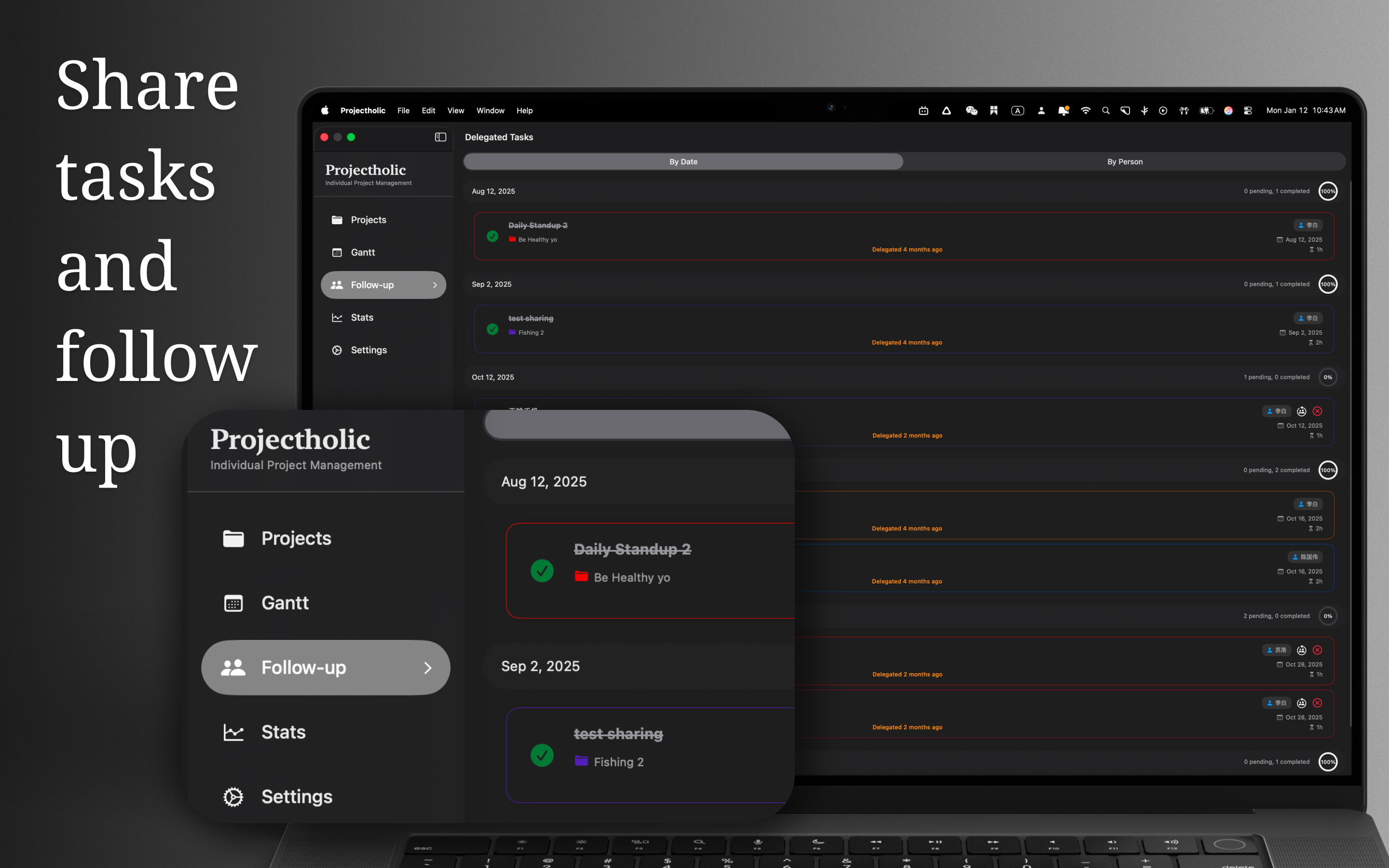
Once you agree on a path, confirm it in a short written message — "Confirming: we're adding the extra page, fee goes up by X, delivery moves to the 14th." Then update the actual project plan so the new scope, fee, or date is visible, not just buried in a chat thread. A visible, shared plan — the kind Projectholic keeps across your devices — means the new reality is in front of both of you, and the next request gets measured against the updated picture rather than the original one.
Scripts you can actually use
Knowing what to do is one thing; having the words ready in the moment is another. Here are lines you can adapt. The shared ingredient is warmth plus a number.
When a request is clearly out of scope:
When you've hit the revision limit:
When you're choosing to absorb something small, on purpose:
Notice that none of these are confrontational. They are friendly, specific, and they always end by handing the decision back to the client. That combination is what lets you hold a boundary without becoming the difficult one.
When to do extra work for free (and when not to)
Holding scope does not mean charging for every comma. Sometimes absorbing a small change is the right move — a genuinely tiny tweak, or a goodwill gesture on a relationship you want to keep for years. Generosity, used deliberately, builds loyalty.
The rule is that free work should be a choice you name, not an invisible default. When you say "I'll include this one at no charge," the client learns two things: that you are generous, and that the work had a real cost you chose to waive. When you absorb it silently, they learn only that more is always available for free — which guarantees the next request. Make the gift visible, and it works for you. Hide it, and it works against you.
Scope is a kindness, not a fight
It is tempting to think of scope management as the adversarial part of freelancing — the part where you stop being the helpful creative and start being the person who says no. It is actually the opposite. A clear scope protects the client as much as you. It keeps the project on time, keeps the budget honest, and keeps the relationship free of the quiet resentment that builds when you are doing far more than you are paid for.
Define the work up front, treat changes as changes, offer options instead of refusals, and keep the plan visible. Do that and scope creep stops being a source of dread. It becomes just another normal conversation — one you are ready for.