Why do projects always take longer than expected?
There is a name for this, and it is comforting to know it is not just you. Psychologists call it the planning fallacy: when we imagine a project, we picture it going well. We see the version where the work flows, the client replies quickly, and nothing surprising appears. We do not picture the third revision, the week the brief changes, or the afternoon lost to a file that will not export.
So the estimate we give is an estimate of the best possible run, not the likely one. And the best possible run almost never happens. This is why even experienced people, who have been burned many times, still produce optimistic numbers. The optimism is baked into how imagination works. You cannot fix it by trying harder to be realistic, because the thing you are imagining is already missing the parts that go wrong.
The good news is that estimating well is a skill, not a personality trait. It comes from changing where the number comes from.
The one shift: estimate from memory, not imagination
The single most reliable improvement to any estimate is to stop asking "how long do I think this will take?" and start asking "how long did this kind of thing actually take last time?"
The first question invites a fantasy. The second forces you to remember real projects, including the messy parts, because the memory comes with the friction attached. Researchers call this reference-class forecasting, which is a formal way of saying: look at a class of similar past work and use its real track record as your anchor.
If the last three landing pages you built each took roughly two weeks of real calendar time, the honest estimate for the next one is two weeks, even if this one feels simpler. It usually felt simpler last time too. Your memory of how long things take is more accurate than your prediction of how long they will take, so lean on the memory.
A step-by-step way to estimate a project
Here is a method that works whether you are quoting a client project or planning your own. It takes about half an hour and produces a number you can stand behind.
1. Break the project into milestones, not tasks
Do not start with a long task list. Long lists feel thorough, but they are where estimates go to die, because the items you forget to list are exactly the ones that cost time. Start instead with the three to seven milestones where the project visibly moves forward — the checkpoints a client could actually review. For a website that might be sitemap, wireframes, design, build, and launch.
Estimating a handful of meaningful outcomes is far more accurate than estimating fifty small tasks, because each milestone naturally absorbs the small unnamed work around it. If you want the full method for this, the guide to breaking a big project into milestones walks through it step by step.
2. Estimate each milestone from a similar past project
Go milestone by milestone and ask the memory question: how long did this same kind of work take the last time I did it? Not the ideal version. The real one, with the revision round and the day it stalled.
If you have never done this kind of work before, that is important information on its own. Find the closest thing you have done, estimate from that, and then weight your buffer higher to account for the genuine unknown. First-time work is not a reason to skip the estimate; it is a reason to be more generous with the cushion.
3. Add a buffer for the work you cannot yet see
Every project contains work that does not exist yet when you estimate it: the feedback that changes direction, the integration that fights back, the asset the client sends late. You cannot list these items, but you can reserve time for the fact that they always appear.
Add twenty-five to fifty percent on top of your honest estimate. Use the lower end for work you have done many times, and the higher end for anything new or heavily dependent on client feedback. The important move is to name what the buffer covers — revisions, handoffs, the unknown — so it reads as planning rather than padding. A named buffer is defensible. An unexplained round number is not.
4. Turn the estimate into a calendar, not a duration
This is the step almost everyone skips, and it causes more missed deadlines than bad estimates do. A project that needs twenty focused hours is not finished tomorrow, because tomorrow does not contain twenty focused hours. It might contain four.
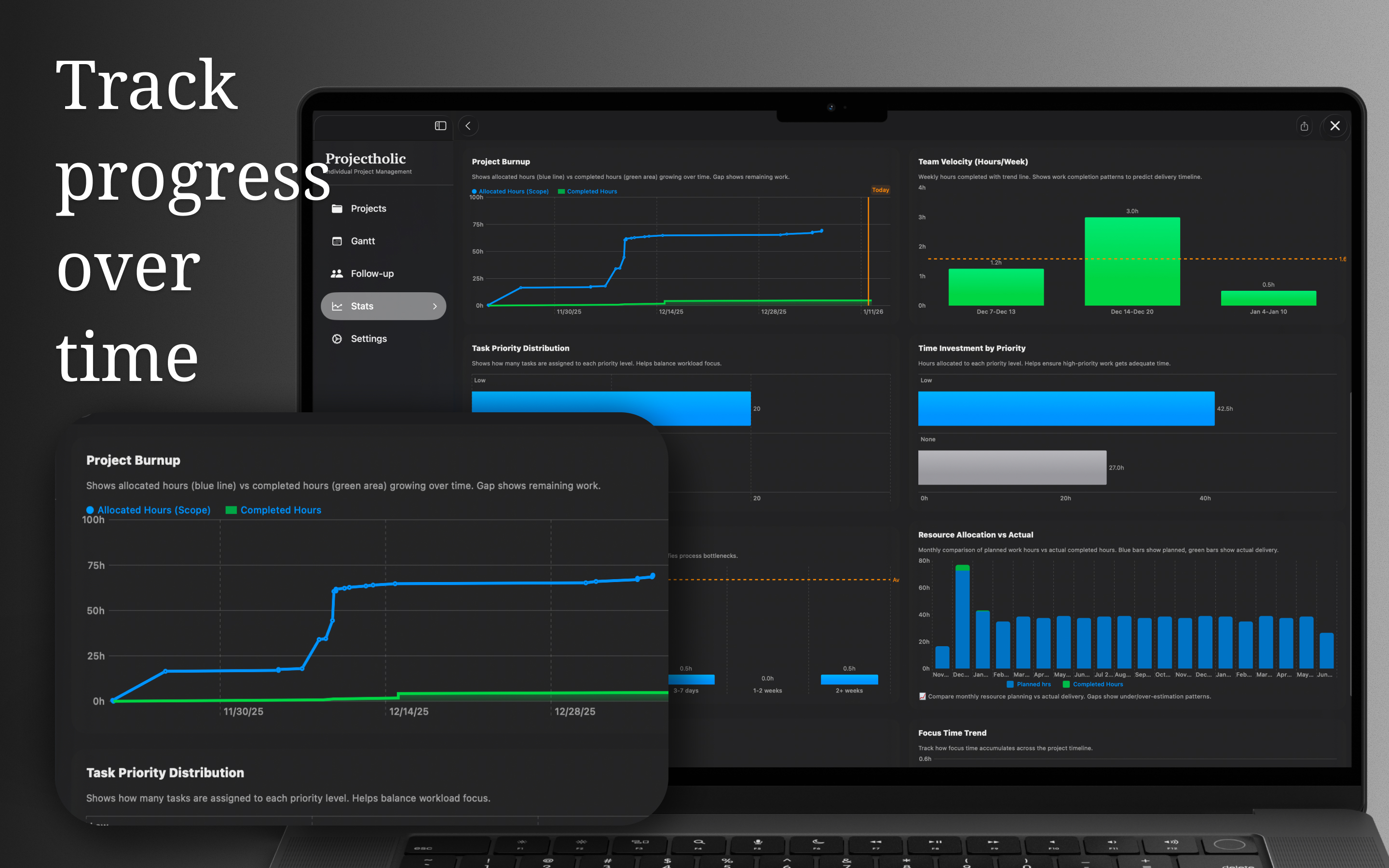
So take your total hours and place them into the real focused time your weeks contain, around the calls, admin, and other projects already there. The output is a delivery date, not a duration. "About thirty hours of work" quietly becomes "ready on the eighth" once it lands on a real calendar — and the eighth is the number your client actually cares about. A planner that shows projects against real time, like Projectholic, makes this last step concrete, but the discipline matters more than the tool: schedule the estimate, do not just quote it.
How big should your buffer really be?
People worry that a visible buffer makes them look slow or padded. In practice the opposite is true. The freelancer who quotes a tight number and then misses it looks far worse than the one who quotes an honest number and hits it. Hitting your dates reliably is one of the most valuable reputations you can build, and it is almost entirely a function of how you buffer.
If you genuinely do not know your own track record yet, start at a forty percent buffer and adjust over a few projects. Keep a simple note of estimated versus actual time for each project. After three or four data points you will know your personal multiplier, and your estimates will get sharp in a way no amount of careful thinking can match.
What if the client wants a smaller number?
They often will. The instinct is to shave the estimate to win the work. Do not shave the estimate — shave the scope instead. Keep your honest number and offer a genuinely smaller version of the project that fits it: fewer revision rounds, a tighter deliverable, one platform instead of three.
This keeps the conversation honest and puts the choice where it belongs, with the client. Cutting the number without cutting the work does not make the work smaller. It just moves the overrun to delivery week, where it is far more expensive — you lose the deadline, the margin, and some trust all at once.
Why a written estimate protects you later
An estimate spoken in a call evaporates. An estimate written down, with its milestones and its stated assumptions, becomes a shared reference. When scope grows later — and it usually does — that written estimate is what lets you say, calmly, "that is new work beyond what we scoped." Without it, every change feels like an argument about memory.
If managing that growth is a recurring problem for you, it is worth reading how to handle scope creep on freelance projects, because a good estimate and a clear scope are two halves of the same protection.
Estimating is a skill, not a guess
The freelancers who seem to magically deliver on time are rarely faster workers. They are better estimators. They have stopped asking their imagination how long things will take and started asking their own track record. They break work into milestones, anchor each one to a real past project, buffer for the unknown on purpose, and place the result on a real calendar before they commit.
None of that requires being a more disciplined person. It requires changing where the number comes from. Do that, and the gap between what you promise and what you deliver starts to close — which is, in the end, the whole job.